Introduction
Some stories don’t begin with thunder, prophecy, or a mysterious stranger in a black coat. Some begin with a boy standing barefoot in the mud, holding a cracked teacup, wondering why the moon has started ticking.
That was how this one began.
On the edge of a small town called Brindlewick, where the roads bent for no sensible reason and cats looked like they knew your secrets, there lived a boy people rarely understood. He wasn’t loud. He didn’t win races. He didn’t have a heroic jawline or a sword hidden under his bed. In fact, he had a habit of losing socks, asking awkward questions, and staring too long at ordinary things until they turned strange.
His mother, Lulu, ran a little repair shop between the bakery and the abandoned post office. She fixed kettles, music boxes, umbrellas, clocks, doorbells, and, once, a mayor’s artificial mustache. People came from miles around because Lulu could mend almost anything, though she always said broken things were only “telling the truth a bit louder.”
Her son believed that too.
And maybe that was why, when the town’s oldest orchard began making mechanical noises after sunset, he didn’t run from it. He leaned closer.
The Quiet Mystery Behind Lulu son
The orchard had been there before anyone cared to remember. Its apple trees grew in crooked rows, their trunks twisted like old hands. In spring, the blossoms smelled faintly of sugar and rain. In autumn, the apples shone gold, red, and green, though nobody ate them anymore. Not since Mr. Pell tried one and spent the next three days speaking fluent pigeon.
Still, the orchard was beautiful in a stubborn, eerie way.
Every night at nine, the trees clicked.
Not snapped. Not rustled. Clicked.
A clean little sound, like gears turning behind bark.
The adults pretended not to hear it. Adults are funny like that. Give them a mystery, and half of them will call it “weather” just to get on with dinner. But children heard it clearly, and dogs barked at it, and spoons trembled in kitchen drawers when the clicking grew loud.
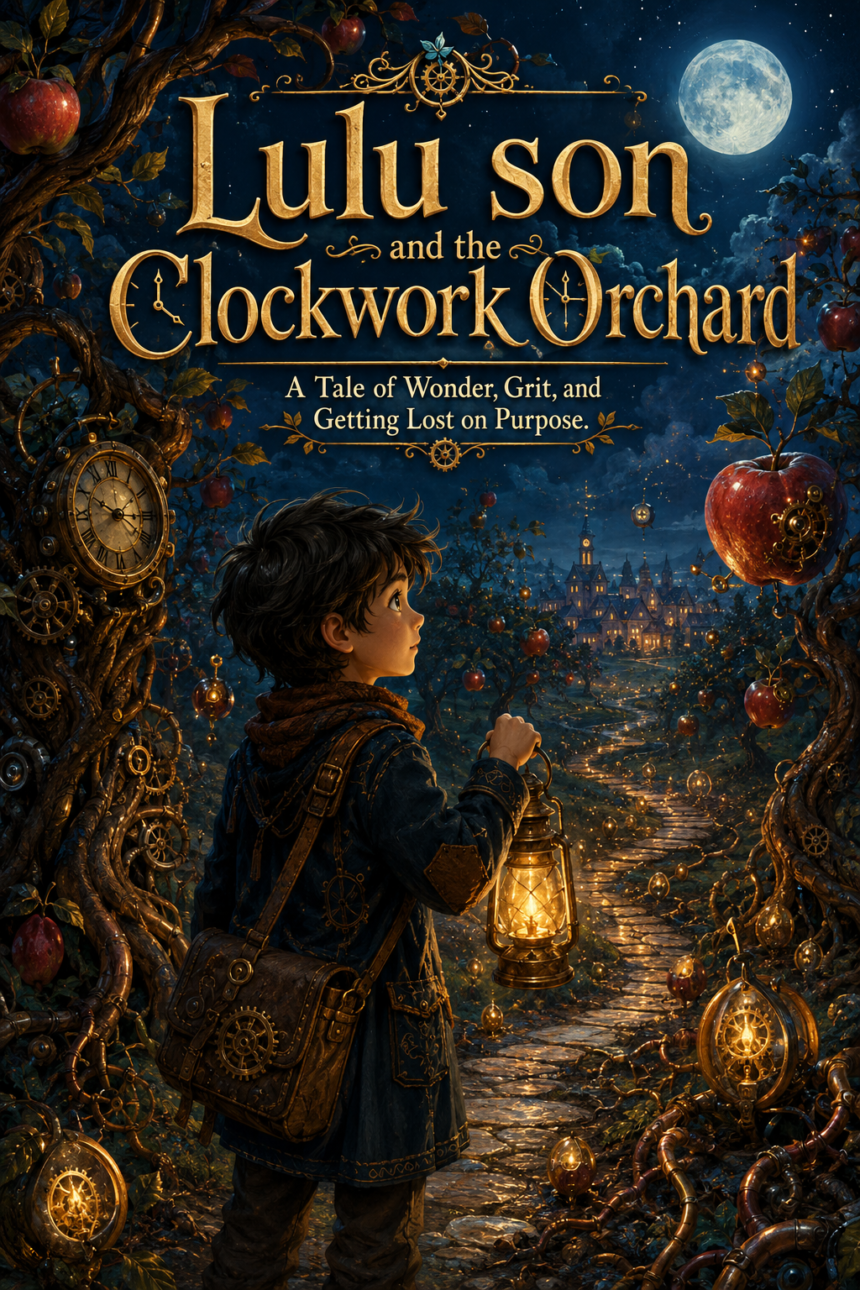
One evening, after the town clock struck nine but forgot to stop, the boy climbed through the orchard fence with a lantern, a notebook, and three biscuits wrapped in a handkerchief.
“Don’t go poking fate with a stick,” his mother had warned.
“I won’t,” he said.
Naturally, he brought a stick.
When Ordinary Places Start Acting Weird
At first, nothing happened. The air was cool. The grass was damp. Somewhere nearby, an owl made a noise like it had just heard disappointing news.
Then the first tree opened.
Not like a door, exactly. More like a yawn. A narrow seam appeared in its trunk, and from inside came a warm amber glow. The boy stepped closer, breath caught halfway in his chest.
Inside the tree, tiny brass gears turned around a glowing seed.
A seed with hands.
A seed with a face.
A seed that looked terribly annoyed.
“You’re late,” it said.
The boy blinked. “I didn’t know I had an appointment.”
“Well, that makes two of us,” said the seed. “But here you are, and here I am, and the orchard’s winding down. Typical.”
This is where a sensible person might’ve screamed, dropped the lantern, and bolted for home. But curiosity, once it grabs your sleeve, doesn’t let go easily. Besides, talking seeds weren’t the strangest thing the boy had met. Mrs. Venn’s parrot could predict rain and insult tax collectors.
“What do you mean, winding down?” he asked.
The seed sighed. “The orchard is a machine, obviously.”
“Obviously?”
“Oh, don’t look at me like that. Mountains are sleeping animals, rivers are letters, and orchards are machines. Everybody knows something nobody else knows.”
That sentence sat in the boy’s mind like a cat on clean laundry.
The Orchard’s Secret Rules
The seed, whose name was Nibblewick, explained that the orchard had once kept time for Brindlewick. Not clock time, the plain old tick-tock kind, but deeper time: the timing of bread rising, babies laughing, rain arriving, friendships healing, and courage showing up just when a person had nearly given up.
But lately, the orchard’s main spring had rusted.
“That’s bad?” the boy asked.
Nibblewick made a tiny choking sound. “Bad? My dear mud-footed visitor, that’s like asking whether a boat dislikes holes.”
If the orchard stopped, time wouldn’t end. No, nothing so dramatic. But life in Brindlewick would slowly lose its rhythm. Bakers would burn bread no matter how carefully they watched it. Musicians would miss beats. Gardeners would plant too early or too late. People would interrupt each other more than usual. Lovers would arrive after the train had gone. Letters would be written and never sent.
Not the end of the world, then.
Just the end of things feeling right.
And honestly, isn’t that sometimes worse?
What the Boy Carried With Him
He didn’t have a sword, as mentioned. No enchanted shield. No ancient royal bloodline. What he carried was less glamorous but more useful.
He had:
- A notebook filled with questions nobody had answered yet.
- A bent screwdriver borrowed from his mother’s workbench.
- Three biscuits, one already crushed.
- A piece of string.
- A stubborn habit of listening before speaking.
- A fear of failure that followed him around like a small, damp dog.
That last part mattered.
A lot of adventure stories skip over fear, or dress it up until it looks noble. But fear is usually not noble. It’s sweaty palms and a dry mouth. It’s wanting to turn back. It’s imagining every possible disaster in quick, colorful detail. Standing beneath the glowing tree, the boy felt fear from his scalp to his toes.
Still, he stayed.
Not because he wasn’t afraid.
Because something needed fixing.
Down the Root-Stairs
Nibblewick told him the main spring lay beneath the orchard, below the root chambers and the worm libraries, past the puddle that reflected tomorrow’s weather.
“Follow the copper roots,” said the seed. “Don’t hum. Don’t bargain with mushrooms. And whatever you do, don’t answer questions asked by your own shadow.”
“Why not?”
“Because it cheats.”
The boy found a staircase under the oldest apple tree. Its steps were made of roots braided with copper wire. Down he went, lantern swinging, biscuits thumping softly against his side.
Walking into the dark, the ceiling seemed to breathe.
There, see? Not every sentence needs to stand perfectly straight. Some should wobble a little. That’s how stories walk when nobody’s watching.
The underground world smelled of wet earth, old pennies, and something sweetly burnt. Tiny beetles wearing silver helmets marched along the walls. A family of pale mushrooms turned their caps away as he passed, muttering, “Rude, rude, very rude,” though he hadn’t said a word.
After a while, the stairs ended in a round chamber where dozens of roots fed into a great brass wheel. It turned slowly, grudgingly, like an old person getting out of a chair.
Then his shadow spoke.
“You’re not clever enough for this.”
The boy froze.
His shadow, stretched long by lantern light, tilted its head. “You’ll break what’s left. That’s what you do, isn’t it? You fiddle. You drop things. You ask questions until people get tired.”
He remembered Nibblewick’s warning. Don’t answer.
So he bit his lip and walked on.
“Coward,” said the shadow.
That one stung.
But he kept walking.
The Three Locks of the Main Spring
At the heart of the orchard, he found the main spring inside a glass dome. It was enormous, coiled like a sleeping dragon, but rust had spread across it in reddish blooms. Around the dome stood three locks.
A note was nailed nearby:
To mend the rhythm, open what was closed. To open what was closed, give what cannot be kept.
“Wonderful,” the boy muttered. “A riddle. Because knobs are too easy.”
Each lock had a symbol.
The first showed an eye.
The second showed a mouth.
The third showed a hand.
The Lock With the Eye
The boy approached the first lock. A brass eyelid opened.
“What do you see that others miss?” it asked.
He almost said “gears,” or “hidden doors,” or “talking seeds.” But those were easy answers, and riddles, nasty little things, rarely wanted the easy answer.
So he thought of his mother’s shop. He thought of cracked cups, bent keys, clocks with missing hands, umbrellas turned inside out by storms. He thought of how Lulu never called anything useless.
“I see that broken things are still trying,” he said.
The lock clicked open.
The Lock With the Mouth
The second lock smiled without teeth.
“What truth have you swallowed?” it asked.
Ah. That was harder.
The boy looked down at his muddy feet. Truths are slippery. The big ones especially. They hide behind jokes, under chores, inside “I’m fine,” and right between the ribs.
“I’m scared I’ll never be as good at fixing things as my mother,” he whispered.
The chamber grew quiet.
Then the second lock opened.
The Lock With the Hand
The third lock stretched out a small metal palm.
“What will you give up?” it asked.
The boy checked his pockets. String. Screwdriver. Biscuits. Notebook.
The notebook hurt to consider. It held every odd thing he had ever noticed: cloud shapes, overheard phrases, diagrams of impossible machines, questions about whether stars got lonely. It was his proof that the world was more interesting than people admitted.
But the note had said: give what cannot be kept.
You can’t keep courage. Not in a jar. Not in a drawer. You have to spend it.
So he placed his fear in the metal hand.
Not literally, of course. Fear doesn’t come out like a coin. But he named it. He let it stand in the open. He admitted it was there, and then he moved anyway.
The third lock opened.
Fixing What Still Wants to Live
The glass dome lifted. The rusty spring groaned.
Now came the actual fixing, and wouldn’t you know it, magic still required elbow grease. The boy scraped rust with the bent screwdriver. He used the string to tie back a bundle of snapping wires. He polished tiny teeth in the gearwork with the edge of his sleeve. He fed crumbs from the crushed biscuit to a pair of exhausted moths turning a pulley overhead.
It wasn’t elegant. It wasn’t heroic in the shiny way.
It was work.
The kind of work where your knees ache and your fingers sting. The kind where you don’t know whether you’re helping until something finally shifts.
And then something did.
The main spring trembled. Once. Twice.
A deep golden sound rolled through the chamber. It wasn’t a bell, not exactly. It was more like the moment before a song becomes singing.
Above him, the orchard woke.
Roots pulsed with light. Gears spun clean. Somewhere far overhead, apples loosened from branches and hovered in the air like little planets.
The boy laughed. He couldn’t help it. It burst out of him, bright and ridiculous.
“Not bad,” said Nibblewick, appearing beside his boot. “For a surface child with biscuit dust on his trousers.”
“Thanks,” he said.
“That wasn’t praise. That was an observation with manners.”
What Changed in Brindlewick
The next morning, the town felt different, though nobody could put a finger on why.
The bakery’s loaves rose perfectly. The school bell rang exactly when it should. Mrs. Venn’s parrot stopped insulting tax collectors and began reciting soup recipes. Two brothers who hadn’t spoken in six months both reached for the same fallen apple and laughed instead of arguing.
Small things.
But small things are the hinges of the world.
The boy returned home at dawn, muddy, tired, and missing one biscuit. Lulu looked up from repairing a music box shaped like a whale.
“You poked fate with a stick, didn’t you?” she said.
“A little.”
“Did fate poke back?”
“Mostly it asked riddles.”
She studied him for a moment, then handed him a clean cloth and a cup of tea.
“Well,” she said, “riddles leave stains too.”
That was her way of saying she was glad he came home. Some people hug with arms. Others hug with tea.
Lessons Hidden in the Orchard
The tale may sound strange, but then again, the best truths often wear silly hats. Under the talking seed and clockwork trees, there are a few ideas worth carrying around.
- Curiosity is not the same as recklessness.
The boy didn’t wander into the orchard because he wanted attention. He went because something was wrong, and he cared enough to learn why. - Fear doesn’t mean failure.
Feeling afraid doesn’t disqualify anyone from doing brave things. Sometimes fear is just proof that the moment matters. - Repair begins with attention.
Whether it’s a machine, a friendship, a habit, or a town’s lost rhythm, you can’t mend what you refuse to notice. - Small acts can reset big patterns.
One repaired spring changed the mood of an entire town. That’s not so far-fetched. One apology, one honest conversation, one kind decision—those things travel. - Being different is sometimes the whole point.
The boy noticed what others ignored. That didn’t make him odd in a useless way. It made him necessary.
Why This Story Sticks
There’s a reason we like stories about hidden worlds. Secret gardens, wardrobes, rabbit holes, doors in walls—we keep coming back to them because they suggest that reality has layers. Maybe the boring street isn’t boring. Maybe the old tree isn’t just an old tree. Maybe the person everyone overlooks is carrying exactly the question that unlocks the whole thing.
And let’s be honest, we all know what it feels like when life loses rhythm. Days blur. Conversations miss their mark. You show up, but not quite on time inside yourself. The clock may be working, but something deeper is offbeat.
That’s where the orchard becomes more than a fantasy setting. It becomes a picture of inner repair.
Not the dramatic kind. The quiet kind.
The kind where you admit what scares you. The kind where you stop pretending everything is fine just because it’s still functioning. The kind where you pick up a bent screwdriver and do the next useful thing.
FAQs
What is the main idea of the story?
The main idea is that courage often looks ordinary from the outside. It isn’t always about grand battles or loud victories. Sometimes it’s about noticing what’s broken, stepping closer, and doing your best with whatever tools you have.
Is the clockwork orchard a real place?
In the story, yes. In ordinary life, maybe not with brass gears and talking seeds. Still, the clockwork orchard can represent any hidden system that keeps life balanced: family routines, personal confidence, creativity, community trust, or emotional rhythm.
Why does the boy succeed when adults ignore the problem?
He succeeds because he listens. The adults dismiss the clicking because acknowledging it would disrupt their comfortable explanations. The boy doesn’t assume he already knows the answer, and that gives him room to discover one.
What does the rusty spring symbolize?
The rusty spring symbolizes neglected rhythm. It might be a tired friendship, a forgotten dream, a town losing kindness, or a person running on habit instead of hope. Rust, in this sense, is what happens when something important goes unattended.
Why are the three locks important?
The locks force the boy to use perception, honesty, and courage. He can’t simply solve the problem with tools. He has to understand what he sees, speak a difficult truth, and give up the comfort of hiding from fear.
Is this story meant for children or adults?
Both, honestly. Children may enjoy the strange orchard, the talking seed, and the underground adventure. Adults may notice the deeper ideas about repair, timing, emotional honesty, and the quiet pressure to ignore problems until they become impossible to miss.
Conclusion
By the time the orchard stopped clicking strangely and began humming properly again, the boy had not become famous. No statue appeared in the town square. No parade marched past Lulu’s repair shop. Nobody gave him a medal shaped like an apple, though frankly, that would’ve been nice.
Instead, life simply improved.
Bread rose. Bells rang. People arrived when they were needed. The town breathed in time again.
And maybe that’s the loveliest kind of victory—the one that doesn’t shout, the one that folds itself into ordinary mornings until everyone feels better without knowing exactly why.
The boy learned something too. He learned that being unsure doesn’t make you useless. He learned that fear can come along for the ride, provided it doesn’t get to hold the map. He learned that broken things aren’t always finished. Some are waiting for the right pair of hands, the right question, the right stubborn heart.