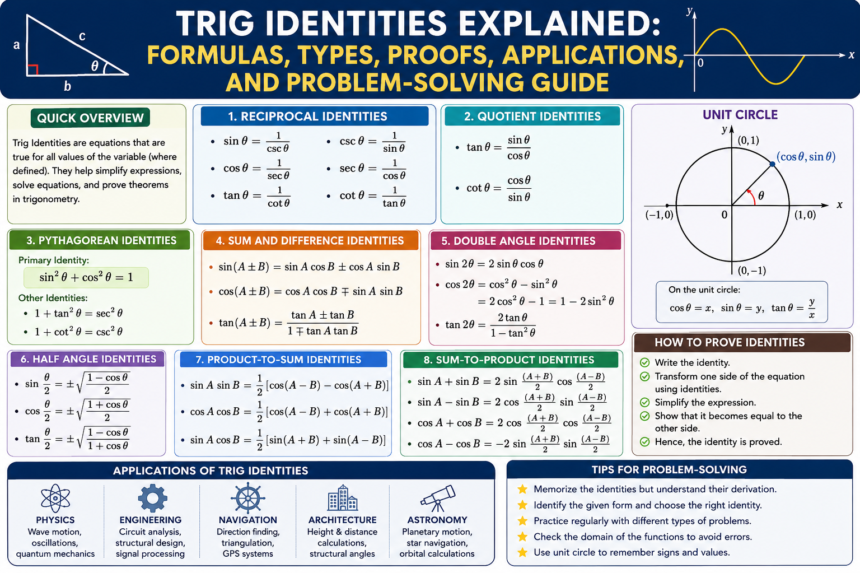
Trigonometry is one of the most important branches of mathematics, and Trig identities are the foundation of solving complex mathematical equations. Whether you’re preparing for school exams, competitive tests, engineering, or higher mathematics, understanding these identities can save time and improve accuracy From basic reciprocal relationships to advanced sum and difference formulas, every identity has a practical purpose. Once you understand how they are derived and applied, solving trigonometric problems becomes much easier This guide covers every major concept related to Trig identities, including their history, formulas, derivations, proofs, applications, common mistakes, and expert learning strategies.
Quick Bio
| Feature | Details |
|---|---|
| Topic | Trig identities |
| Definition | Mathematical equations that remain true for all valid values of trigonometric variables |
| Origin | Ancient Greek, Indian, and Islamic mathematics |
| Primary Use | Simplifying expressions and solving trigonometric equations |
| Academic Field | Mathematics and Trigonometry |
| Difficulty Level | Beginner to Advanced |
| Core Functions | Sine, Cosine, Tangent, Cotangent, Secant, Cosecant |
| Popular Applications | Physics, Engineering, Architecture, Astronomy, Navigation, Computer Graphics |
| Common Formula Groups | Reciprocal, Quotient, Pythagorean, Sum & Difference, Double Angle, Half Angle |
| Importance | Essential for calculus, geometry, and higher mathematics |
What Are Trig Identities?
Trig identities are mathematical equations involving trigonometric functions that remain true for every value within their domain. Unlike ordinary equations that are true only for specific values, identities always hold true as long as both sides are defined.
These identities make it possible to simplify complicated expressions, prove mathematical statements, and solve equations involving angles. They are among the first advanced concepts students encounter after learning the six trigonometric functions.
Understanding these identities strengthens logical thinking and builds the foundation for calculus, differential equations, linear algebra, and engineering mathematics.
History and Origin of Trigonometric Identities
The development of trigonometry spans thousands of years. Ancient civilizations studied angles and triangles primarily for astronomy and land measurement.
Greek mathematicians, especially Hipparchus and Ptolemy, laid the groundwork for trigonometric calculations. Later, Indian scholars introduced refined sine tables, while Islamic mathematicians expanded trigonometric theory and established many relationships that resemble today’s Trig identities.
Modern mathematics organizes these discoveries into structured formulas used worldwide in schools, universities, and scientific research.
Understanding the Six Trigonometric Functions
Every identity is built using six fundamental trigonometric functions.
- Sine (sin)
- Cosine (cos)
- Tangent (tan)
- Cotangent (cot)
- Secant (sec)
- Cosecant (csc)
These functions describe relationships between the angles and sides of a right triangle. On the unit circle, they also represent coordinates and ratios that remain consistent regardless of triangle size.
A strong understanding of these six functions makes learning every identity significantly easier.
Reciprocal Identities
The reciprocal identities connect each function with its inverse ratio.
Formulas
- sin θ = 1 / csc θ
- csc θ = 1 / sin θ
- cos θ = 1 / sec θ
- sec θ = 1 / cos θ
- tan θ = 1 / cot θ
- cot θ = 1 / tan θ
These identities are commonly used when simplifying fractions involving trigonometric functions.
Quotient Identities
Quotient identities express tangent and cotangent using sine and cosine.
Formulas
- tan θ = sin θ / cos θ
- cot θ = cos θ / sin θ
These relationships help convert complicated expressions into simpler forms and are frequently used in algebraic manipulation.
For example, replacing tangent with sine divided by cosine often allows terms to cancel easily during simplification.
Pythagorean Identities
Among all Trig identities, the Pythagorean identities are the most frequently used.
Primary Identity
sin² θ + cos² θ = 1
From this equation we derive:
- 1 + tan² θ = sec² θ
- 1 + cot² θ = csc² θ
These identities originate from the Pythagorean Theorem and apply to every point on the unit circle.
Students preparing for exams should memorize these three formulas because they appear repeatedly in proofs and problem-solving.
Why Trig Identities Matter in Mathematics
Learning formulas without understanding their purpose often leads to confusion.
Trig identities help mathematicians:
- Simplify lengthy expressions
- Solve complex equations
- Verify mathematical proofs
- Model real-world phenomena
- Analyze periodic functions
- Study waves and oscillations
Without these identities, many advanced mathematical problems would require much longer calculations.
How to Prove Trigonometric Identities
A proof demonstrates that two expressions are mathematically equivalent.
Some common strategies include:
- Converting everything into sine and cosine
- Applying reciprocal identities
- Using quotient identities
- Factoring expressions
- Applying Pythagorean identities
- Simplifying only one side until both sides match
A useful habit is to avoid changing both sides simultaneously. Instead, simplify the more complicated side step by step.
Common Examples
Example 1
Prove:
tan θ × cos θ = sin θ
Replace tangent using the quotient identity:
tan θ = sin θ / cos θ
Therefore,
(sin θ / cos θ) × cos θ = sin θ
Both sides become equal.
Example 2
Simplify:
1 − sin² θ
Using the Pythagorean identity,
1 − sin² θ = cos² θ
This single substitution dramatically shortens many calculations.
Common Mistakes Students Make
Many learners struggle with Trig identities because they rely on memorization instead of understanding relationships.
The most common mistakes include:
- Mixing reciprocal and quotient identities
- Forgetting domain restrictions
- Incorrectly expanding squared expressions
- Using the wrong angle formulas
- Skipping intermediate algebraic steps
- Memorizing without regular practice
Working through proofs rather than only reading formulas helps build confidence and accuracy.