A food web is one of the clearest ways to understand how life stays connected.
It shows who eats whom, where energy moves, and how small changes can affect an entire ecosystem.
This guide explains the concept in a simple, useful, and research-backed way.
Quick Bio
| Feature | Details |
|---|---|
| Core definition | A food web is a network of feeding relationships among organisms in an ecosystem. |
| Main idea | It shows how energy, nutrients, and biomass move from one organism to another. |
| Origin of concept | The idea grew from early studies of food chains and became central in ecology through work linked to Charles Elton’s 1927 book Animal Ecology. |
| Primary use | Used to explain ecosystem structure, species interactions, energy transfer, and ecological balance. |
| Field/industry | Ecology, environmental science, conservation biology, fisheries, agriculture, education, restoration planning, and ecotoxicology. |
| Main components | Producers, primary consumers, secondary consumers, tertiary consumers, decomposers, predators, prey, and detritus. |
| Common “materials” | Living organisms, dead organic matter, sunlight, nutrients, biomass, water, soil, and chemical energy. |
| Popular applications | Classroom diagrams, wildlife management, ocean studies, invasive species analysis, pollution tracking, and habitat restoration. |
| Related terms | Food chain, trophic level, energy flow, ecological network, predator-prey relationship, biodiversity, biomass pyramid. |
| Simple example | Grass → grasshopper → frog → snake → hawk, connected with many other feeding links. |
What Is a Food Web?
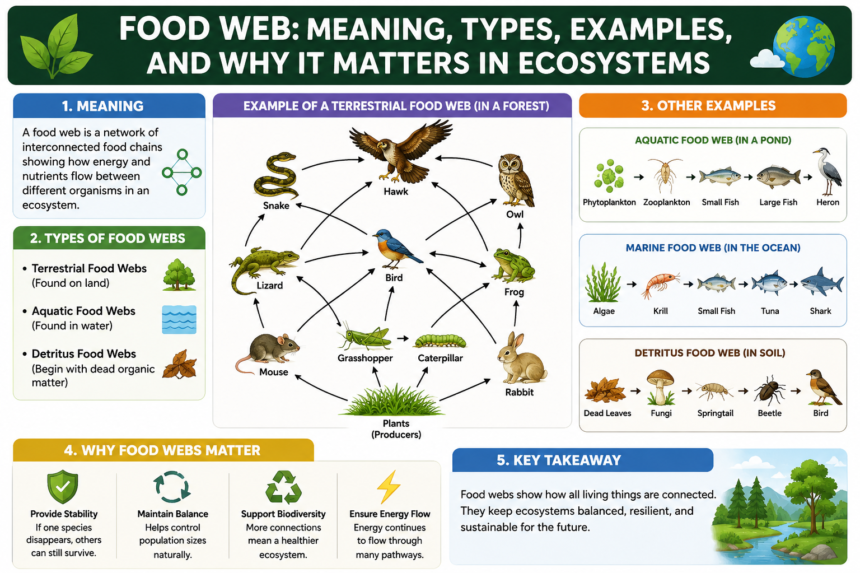
A food web is a map of feeding connections inside an ecosystem. Instead of showing one straight line of “who eats whom,” it shows many overlapping pathways because most organisms eat more than one thing and are eaten by more than one predator.
Nature Education describes food webs as tools used to show feeding relationships among species in a community, with organisms grouped into basal species, intermediate species, and top predators. Basal species such as plants form the lowest trophic level because they convert solar energy into chemical energy.
Simple Definition
In plain words, a food web is the “eating network” of a habitat. It may include plants, algae, insects, birds, mammals, fungi, bacteria, and countless microscopic organisms.
This makes it more realistic than a food chain. A rabbit may eat grass, clover, and bark; a fox may eat rabbits, rodents, birds, and insects. One simple line cannot capture that complexity.
Why the Concept Matters
A food web helps explain why one missing species can change many others. Remove a predator, and prey numbers may rise. Reduce plant cover, and herbivores may decline. Pollute a river, and toxins may move into fish, birds, and mammals.
That is why ecologists use this concept for conservation planning, climate impact studies, fisheries management, and restoration work.
Food Web vs Food Chain
A food chain is a single route of energy transfer. For example: grass → deer → wolf. It is useful for beginners because it shows direction clearly.
A food web combines many food chains into one larger network. It reflects real ecosystems better because animals rarely depend on only one food source.
The difference is simple: a chain is linear; a web is connected. A chain teaches the basic pathway, while the web reveals the full ecological picture.
History of the Food Web Concept
The roots of the idea go back to naturalists who noticed that animals and plants depend on one another through feeding relationships. Charles Elton helped shape modern animal ecology by discussing food chains, food cycles, and trophic roles in Animal Ecology in 1927.
Early diagrams made these relationships easier to see. Over time, the food web became one of ecology’s core models because it connected field observations with measurable patterns such as population size, predator-prey links, and energy movement.
Today, researchers use network models, stable isotope analysis, remote sensing, and long-term field data to study these relationships in forests, rivers, oceans, farms, and cities.
Main Components of a Food Web
Every food web has basic roles. The names may sound technical, but the idea is easy: some organisms make food, some eat, and some recycle what remains.
Producers
Producers are organisms that make their own food. Plants, algae, and phytoplankton use sunlight to produce energy-rich organic matter.
They sit at the base of most ecosystems. Without producers, energy has no strong entry point into the living system.
Consumers
Consumers eat other organisms. Primary consumers eat producers, secondary consumers eat herbivores, and tertiary consumers feed at higher levels.
Consumers include insects, fish, reptiles, birds, mammals, and many invertebrates. Omnivores, such as bears and humans, can feed at more than one trophic level.
Decomposers and Detritivores
Decomposers such as fungi and bacteria break down dead organic matter. Detritivores like earthworms, termites, dung beetles, and some crustaceans physically process waste and dead material.
USGS educational material explains that decomposers release stored nutrients for reuse, allowing producers to begin the cycle again. This recycling role keeps ecosystems productive instead of letting nutrients stay locked inside dead tissues.
Trophic Levels and Energy Flow
A trophic level is a feeding position. Producers occupy the first level, herbivores the second, carnivores higher levels, and decomposers work across the system.
Energy usually decreases as it moves upward. Some energy becomes body heat, some is used for movement and metabolism, and some remains unavailable to the next consumer.
This energy loss explains why ecosystems normally support fewer top predators than herbivores or plants. A forest can feed many insects and deer, but only a smaller number of foxes, owls, or large cats.
Types of Food Webs
Not all ecosystems are built the same way. Scientists often describe webs by habitat, energy source, or dominant pathway.
Terrestrial Food Web
A terrestrial system occurs on land. Examples include forests, grasslands, deserts, farms, and mountain habitats.
A grassland network might connect grasses, seeds, grasshoppers, rodents, snakes, foxes, hawks, fungi, and soil bacteria. Seasonal rainfall can quickly change which links become strongest.
Aquatic Food Web
An aquatic system occurs in water. It includes freshwater lakes, rivers, wetlands, estuaries, coral reefs, and open oceans.
NOAA notes that phytoplankton are major primary producers in marine environments, eaten by zooplankton or krill, which are then eaten by small fish and larger animals. This tiny base supports some of the largest animals on Earth.
Detrital Food Web
A detrital system begins with dead organic matter instead of living plants. Fallen leaves, dung, dead fish, wood, and animal remains become energy sources for microbes and detritivores.
This pathway is often overlooked, but it is powerful. In soils, rivers, and forest floors, decomposer-based links can control nutrient cycling and plant growth.
Food Web Examples in Real Ecosystems
A pond may include algae, duckweed, mosquito larvae, snails, tadpoles, small fish, dragonfly nymphs, frogs, turtles, herons, raccoons, bacteria, and fungi. Many of these organisms connect in multiple directions.
A desert food web may include shrubs, seeds, ants, grasshoppers, lizards, rodents, snakes, owls, foxes, vultures, and soil microbes. The limited water supply makes each link more sensitive to drought.
In the ocean, phytoplankton feed zooplankton; zooplankton feed fish larvae, small fish, krill-feeding whales, seabirds, and larger predators. NOAA explains that many zooplankton eat phytoplankton and are then eaten by larger animals, making them a crucial bridge between microscopic producers and visible marine life.
How a Food Web Diagram Is Made
A good diagram starts with the ecosystem boundary. That boundary could be a school garden, coral reef, lake, wheat field, mangrove forest, or national park.
Next, list the organisms and sort them into roles: producer, herbivore, carnivore, omnivore, decomposer, or detritivore. Then draw arrows from the food source to the organism that eats it.
The arrow direction matters. It should show energy flow, not just “who attacks whom.” If grass is eaten by a rabbit, the arrow points from grass to rabbit.
Role in Biodiversity and Stability
Biodiversity gives an ecosystem more options. If one prey species declines, a predator may survive by eating another. If one plant suffers from disease, herbivores may switch to a different plant.
Still, complexity is not magic protection. Some links are stronger than others. A single keystone predator, pollinator, host plant, or decomposer group can carry unusual influence.
Nature Education highlights Robert Paine’s rocky intertidal work, where removing a starfish predator reduced prey-species richness in experimental plots from 15 to 8 after two years. That example shows how one predator can shape diversity through indirect effects.
Food Webs in Oceans, Lakes, and Rivers
Water-based systems often depend heavily on microscopic life. Phytoplankton, algae, bacteria, protozoa, copepods, krill, larvae, shellfish, fish, seabirds, and marine mammals can all be linked.
In rivers, the network may also include leaves falling from nearby trees. Those leaves feed microbes and invertebrates, which then support fish and other predators.
This is why river restoration cannot focus only on water flow or one target species. USGS research on river restoration notes that recovery projects can affect the wider network of competitors, predators, and prey through changes in energy flow.
Human Impact on Food Web Balance
Human activity can weaken or reshape feeding relationships. Habitat loss removes shelter and food. Pesticides reduce insects. Overfishing can remove predators. Fertilizer runoff can trigger algal blooms that reduce oxygen in water.
Pollution can also move through living networks. USGS describes contaminant bioaccumulation research as a way to quantify the transfer of contaminants through food webs and identify ecological mechanisms behind differences in transfer rates.
Climate change adds another pressure. When temperature, rainfall, acidity, or seasonal timing shifts, producers and consumers may no longer match each other’s life cycles.
Modern Applications in Science and Industry
The food web is not only a classroom topic. It is used in environmental consulting, fisheries, wildlife management, agriculture, invasive species control, ecotoxicology, and climate risk assessment.
In fisheries, scientists study who eats juvenile fish and what those juveniles need to survive. In agriculture, farmers and researchers examine pest insects, natural predators, soil organisms, crop plants, and pollinators.
Restoration teams use network thinking to avoid narrow fixes. Replanting vegetation, removing invasive species, reconnecting side channels, or restoring wetlands can help one species while unexpectedly changing competitors or predators.
Common Mistakes When Learning Food Webs
One common mistake is thinking the top predator is always the most important organism. Top predators matter, but producers and decomposers often control the energy and nutrient base.
Another mistake is ignoring omnivores. Many animals eat across levels, so placing them in one fixed box can oversimplify the system.
A third mistake is drawing arrows backward. The arrow should follow energy from food to eater, such as seed → mouse → owl.
Future of Food Web Research
The future of this field is moving toward better data. Researchers now combine field surveys, DNA analysis, satellite observations, animal tracking, chemical markers, and computer modeling.
This can help predict which ecosystems are most vulnerable before damage becomes obvious. It can also show how invasive species, warmer oceans, changing rainfall, or pollution may redirect energy pathways.
For students, the key lesson is clear: a food web is not a static picture. It is a living network that changes with seasons, disturbance, migration, reproduction, and human pressure.
FAQs About Food Web
1. What is a food web in simple words?
A food web is a picture or explanation of how living things in an ecosystem get food from one another. It shows many connected food chains rather than one straight path.
For example, grass may feed rabbits, deer, and insects. Those animals may then feed foxes, owls, snakes, or hawks. The network shows how energy moves through the whole habitat.
2. Why is a food web more useful than a food chain?
A food chain is easier to read, but it is too simple for real ecosystems. Most organisms have several food sources and several predators.
A food web gives a better view of ecological balance because it shows multiple pathways. This helps explain why a change in one species can affect many others.
3. What are the main parts of a food web?
The main parts are producers, consumers, decomposers, predators, prey, and detritus. Producers bring energy into the system, consumers pass it along, and decomposers recycle nutrients.
These roles connect through trophic levels. Together, they explain how energy and matter move through a habitat.
4. How do humans affect a food web?
Humans affect feeding networks through deforestation, pollution, overfishing, hunting, pesticide use, climate change, and invasive species movement. Even one change can create a ripple effect.
For instance, removing insects can affect birds, bats, reptiles, amphibians, and pollination. Pollution may also move from small organisms into larger predators.
5. Can a food web change over time?
Yes. It changes with seasons, weather, migration, disease, reproduction, habitat disturbance, and species introductions.
A pond in spring may have different feeding links than the same pond in late summer. Long-term climate shifts can also change which species survive, reproduce, or move into a region.
Conclusion
A food web is the clearest way to see that no organism lives alone. It connects sunlight, plants, animals, fungi, bacteria, nutrients, predators, prey, and people into one working system.
For learning, start with one habitat and list its producers, consumers, and decomposers. Then draw arrows in the direction of energy flow. For real-world action, protect habitat, reduce pollution, support biodiversity, and treat every species as part of a larger network. When those links stay healthy, ecosystems become more resilient, productive, and alive.