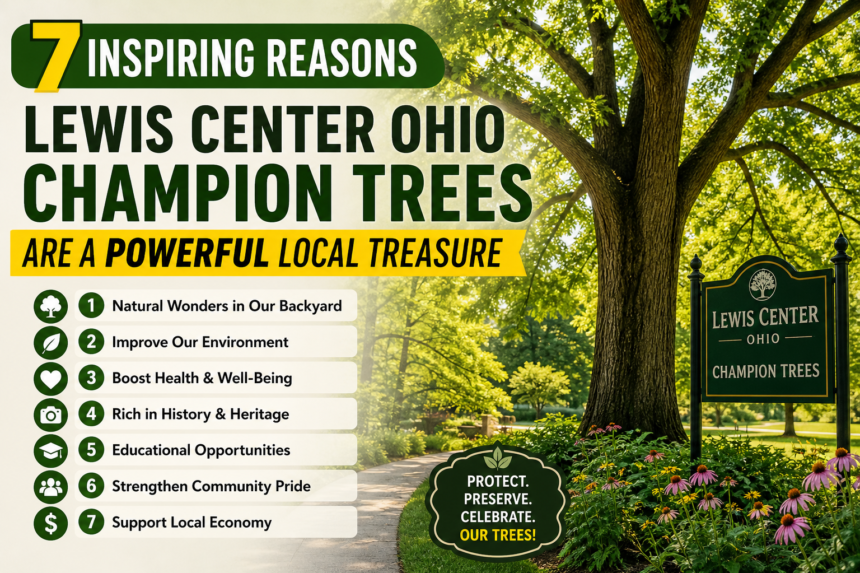
Trees can be quiet, but they have a powerful way of telling a story. Around Lewis Center, Ohio, the search for remarkable trees leads people toward old oaks, broad sycamores, towering cottonwoods, and protected forest pockets that still feel wonderfully wild. While not every large tree is officially crowned a champion, the local landscape near Highbanks Metro Park, Alum Creek, and Delaware County gives tree lovers plenty to admire.
The Ohio Big Tree Program is listed as Ohio’s state champion tree program and is housed under the Ohio Department of Natural Resources, according to the National Champion Tree Program’s state program directory.
What Champion Trees Mean in Ohio
A champion tree is usually the largest known tree of its species within a state or the nation. It is not just “a big tree.” It must be measured, recorded, compared, and verified. That makes champion trees part science, part community pride, and part treasure hunt.
The National Champion Tree Program explains that champion tree scoring uses three measurements: height, trunk circumference, and average crown spread. The formula is height in feet plus circumference in inches plus one-quarter of the average crown spread in feet.
State Champion Trees vs. National Champion Trees
A state champion tree is the largest known tree of its species in one state. A national champion tree is the largest known tree of its species in the country. So, a massive Ohio white oak may be a local wonder without being the state champion, and a state champion may still have to compete with huge trees from other states.
This matters for Lewis Center because many local trees may be “champion-size” even if they are not listed as official champions. Local groups such as Big Trees Ohio have documented impressive white oaks in the Lewis Center and Delaware County area, while also noting a former state champion eastern cottonwood at Alum Creek State Park nearby.
The Official Big Tree Point Formula
The scoring system is simple enough for beginners to understand, but careful enough to reward truly massive trees.
| Measurement | What It Means | Why It Matters |
|---|---|---|
| Circumference | Around the trunk, usually near breast height | Shows girth and age potential |
| Height | From ground to the highest living point | Shows vertical growth |
| Crown spread | Width of the leafy canopy | Shows overall reach and structure |
| Total points | Combined champion score | Helps compare trees of the same species |
The National Champion Tree Program also says trees must have measurements from within the past 10 years to be eligible for the next champion register.
Why lewis center ohio champion trees Deserve Local Attention
Lewis Center sits near one of central Ohio’s most loved natural areas: Highbanks Metro Park. Highbanks is not only beautiful, but also ecologically rich. Columbus Metro Parks describes Highbanks as a 1,204-acre park named for its 100-foot shale bluff above the Olentangy State Scenic River. The park includes deep ravines, exposed shale, and several trails through forested land.
That setting helps explain why tree lovers pay attention to the area. Highbanks includes forest trails where visitors can see sycamore, buckeye, cottonwood, oak, maple, and hickory communities. The park’s Sycamore Trail, for example, winds through sycamore, buckeye, and cottonwood forest beside the river.
Highbanks Metro Park and the Local Tree Landscape
Highbanks is located at 9466 Columbus Pike in Lewis Center, and its trail system gives everyday visitors a safe way to enjoy large trees without trespassing or damaging sensitive habitats.
The Old-Growth Forest Network notes that the Edward F. Hutchins Nature Preserve at Highbanks covers 206 acres and includes a mix of old-growth and younger trees, mainly oak, maple, and hickory.
White Oaks, Sycamores, Cottonwoods, Maples, and Hickories
Several species near Lewis Center can grow into impressive giants. White oaks can develop huge crowns and thick trunks. Sycamores love river corridors and often grow wide, pale trunks. Cottonwoods grow fast and can become enormous near streams and reservoirs. Maples and hickories add structure, food, and wildlife value to mature forests.
Preservation Parks of Delaware County explains that Ohio’s large trees are often found in old-growth tracts, cemeteries, near old homes, or on private land. It also notes that Ohio’s biggest known trees are recorded by ODNR and scored by trunk circumference, crown spread, and height.
Where Tree Lovers Can Look Near Lewis Center
The best place to start is public land. Highbanks offers marked trails, parking, nature programs, and clear rules. That makes it ideal for families, hikers, photographers, and school groups.
Good viewing areas include:
| Area | Why It Helps Tree Seekers |
|---|---|
| Highbanks Sycamore Trail | River trees, sycamore, buckeye, cottonwood |
| Highbanks Overlook Trail | Forest, ravines, preserve views |
| Scenic River Trail | Easy forest and river access |
| Alum Creek area | Large floodplain and park trees nearby |
| Older neighborhoods and farm edges | Possible large oaks, but often private |
Visitors should stay on public trails, respect private property, and avoid posting exact locations of sensitive trees when doing so could invite damage.
How to Nominate a Possible Champion Tree
Finding a possible champion begins with observation. Look for a tree that seems unusually large for its species, then identify it correctly. A huge silver maple should not be compared with a white oak, and a cottonwood should not be compared with a sycamore.
Next, measure it safely. The National Champion Tree Program recommends measuring height, circumference, and crown spread, and it gives public submitters room to provide preliminary estimates when professional tools are not available.
Safe Measuring Tips for Families and Volunteers
Bring a flexible tape measure, notebook, phone camera, and a field guide or tree ID app. Measure the trunk carefully, but do not climb the tree, break branches, cross fences, or step into unsafe riverbanks.
A simple family-friendly process looks like this:
- Identify the species.
- Measure trunk circumference.
- Estimate height carefully.
- Measure crown spread from two directions.
- Take clear photos.
- Record location details respectfully.
- Submit the tree through the proper Ohio program contact.
Because Ohio’s Big Tree Program is housed under ODNR, nominations and questions should be directed through official Ohio champion tree resources.
Why Big Trees Matter for Wildlife, Shade, Carbon, and Community Pride
Large trees do more than look impressive. They cool trails, shelter birds, hold soil, feed insects, support fungi, and store carbon. Older forests also build healthier soil over time through leaf litter, decaying wood, and deep root systems.
Columbus Metro Parks explains that old-growth forests support biodiversity, cycle nutrients, help produce topsoil, and store carbon in trunks and woody material.
Big trees also give a town identity. A beloved oak near a school, a giant sycamore along a river, or an old cottonwood in a park can become a living landmark. People remember where they picnicked, walked, took photos, or taught their kids the names of leaves.
Protecting Historic Trees from Development and Damage
Champion status does not always mean automatic protection. The National Champion Tree Program notes that champion trees are generally not legally protected from removal or damage unless a local ordinance gives them protection.
That is why local care matters. Big trees need room for roots, clean soil, limited compaction, and thoughtful pruning by qualified professionals. Construction can be especially harmful because root damage and soil compaction may not show up right away. The National Champion Tree Program warns that construction damage can weaken trees for years and stresses the importance of protecting the critical root zone.
For homeowners, schools, churches, and developers near Lewis Center, the best step is simple: plan around the tree before work begins. A fence around the root zone, a no-parking rule under the canopy, and an ISA-certified arborist’s advice can save a tree that took centuries to grow.
Frequently Asked Questions About Champion Trees Near Lewis Center
1. Are there official champion trees in Lewis Center, Ohio?
Public sources clearly show that Lewis Center is near major big-tree habitat, especially Highbanks Metro Park. However, not every large local tree is publicly mapped as an official champion. Some notable large trees in the area are documented by local big-tree groups rather than listed as current official champions.
2. What is the best public place to see large trees near Lewis Center?
Highbanks Metro Park is the best starting point. It has marked trails, river forest, ravines, sycamores, cottonwoods, oaks, and a 206-acre nature preserve.
3. Can I nominate a tree from private property?
Yes, but only with permission from the property owner. Never enter private land without approval. A tree can be special, but safety and respect come first.
4. What species near Lewis Center are good champion candidates?
White oak, sycamore, eastern cottonwood, maple, hickory, and other mature hardwoods are worth noticing. River corridors and old farm edges can produce especially large trees.
5. Does a champion tree receive legal protection?
Not always. Champion trees are generally not automatically protected unless local rules or ordinances protect them.
6. How often do champion tree records change?
They can change when a bigger tree is found, when a tree dies, or when old measurements expire. National eligibility requires measurements within the past 10 years.
Conclusion: A Bigger Future for Ohio’s Biggest Trees
The story of lewis center ohio champion trees is really a story about attention. When people slow down and notice a giant oak, a riverside sycamore, or a towering cottonwood, they begin to see their community in a richer way. Lewis Center has the right mix of protected land, river forest, old-growth pockets, and local curiosity to make big-tree exploration meaningful.
Champion trees remind us that nature is not far away. Sometimes, it is standing beside a trail, shading a road, guarding a creek, or growing quietly behind a school. With careful measuring, respectful viewing, and strong community care, the biggest trees near Lewis Center can keep inspiring people for generations.