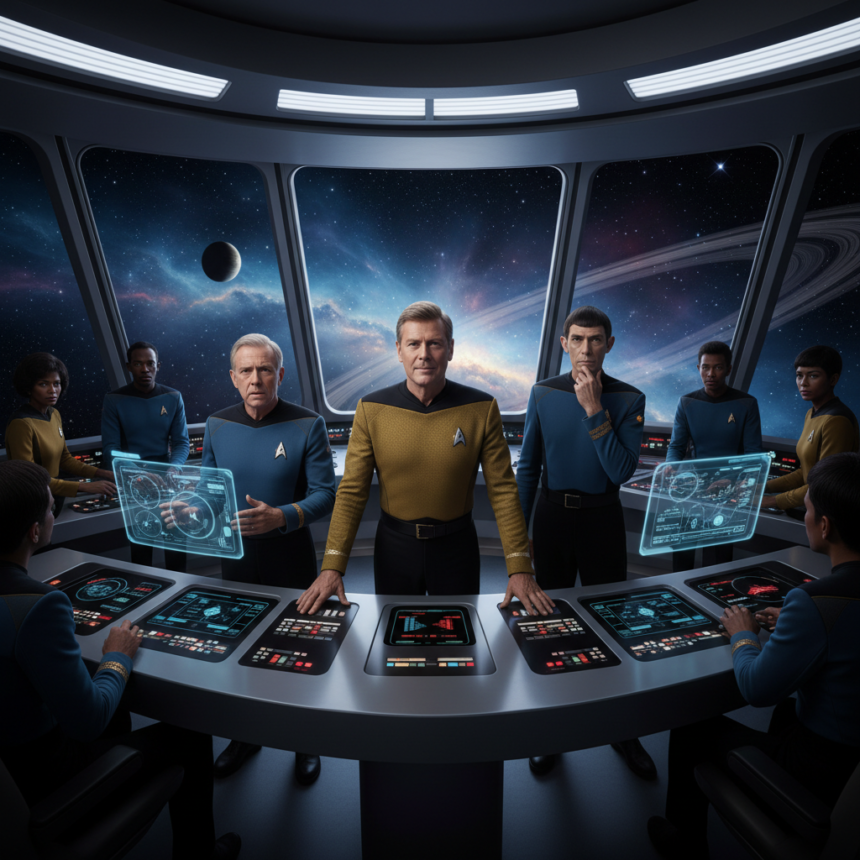
When you think of deep-space exploration and intergalactic diplomacy, one name instantly comes to mind. James Tiberius Kirk is the gold standard for starship commanders. He commands the USS Enterprise with a unique blend of swagger, empathy, and tactical genius. For decades, audiences have watched him explore strange new worlds, seek out new life, and boldly go where no one has gone before.
Captain Kirk is far more than a fictional astronaut. He represents the very best of human potential. As an iconic figure in pop culture, his character helped redefine how audiences view leadership on television. He showed that a commander could be tough yet compassionate, logical yet deeply emotional. This complex mixture transformed a simple 1960s science fiction show into a global phenomenon.
Understanding Captain Kirk requires looking at his origins, his distinct leadership style, and his deep connections with his crew. This guide explores his significance across television, film, and popular culture. You will learn how his character was developed, why his adventures still resonate today, and how his legacy continues to shape science fiction storytelling.
The Genesis of Captain Kirk
The creation of this legendary character involved a mix of brilliant writing and perfect casting. The character we know today went through several iterations before finally hitting the screen.
Gene Roddenberry’s Vision
Series creator Gene Roddenberry originally envisioned his starship captain as a Horatio Hornblower figure in space. He wanted a man of action who also possessed a deep, philosophical intellect. The very first pilot episode actually featured a different captain named Christopher Pike. When the network requested a second pilot, Roddenberry retooled the lead role, resulting in the creation of James T. Kirk.
William Shatner’s Casting
Finding the right actor was crucial. William Shatner stepped into the role, bringing a theatrical background and undeniable screen presence. His dynamic performance style injected the character with a vital energy. Shatner’s distinct cadence, expressive body language, and dramatic pauses gave the captain a magnetic charm that immediately captured the audience’s attention.
Evolution During The Original Series
Throughout the three seasons of Star Trek: The Original Series, the character grew significantly. He started as a somewhat rigid military man but quickly softened into an empathetic, deeply human leader. The writers began to highlight his reliance on his crew, shifting him away from the lone-wolf archetype. This evolution turned him into a relatable hero who relied on teamwork as much as his own instincts.
Key Characteristics and Leadership Style
What makes him such an effective leader? His approach to commanding a starship is a fascinating study in management, risk assessment, and human psychology.
Bravery and Risk-Taking
Space is incredibly dangerous, and this captain never shies away from a threat. He frequently beams down with the landing party, leading from the front rather than hiding on the bridge. This willingness to put himself in harm’s way earns the absolute loyalty of his crew. He takes calculated risks, trusting his intuition when the ship’s sensors and computer models fail to provide a clear answer.
A Strong Moral Compass
Despite his rebellious streak, he operates with a profound dedication to Starfleet principles. The Prime Directive—which forbids interference with the natural development of alien civilizations—is his guiding star. However, he is not afraid to bend the rules when innocent lives are at stake. His morality is driven by a deep respect for all life forms, no matter how alien they may seem.
Charisma and Inspiration
He possesses a natural magnetism. He knows how to speak to his crew, offering words of encouragement during their darkest hours. His speeches are legendary, often reminding his officers of their shared humanity and the noble purpose of their mission. This charisma makes people want to follow him into the unknown.
The Kobayashi Maru Approach
Perhaps the most famous example of his problem-solving ability is the Kobayashi Maru test. This Starfleet Academy simulation is famously designed to be a no-win scenario. Instead of accepting defeat, a young cadet Kirk reprogrammed the simulation so he could rescue the stranded ship. He simply does not believe in a no-win scenario. This refusal to accept defeat defines his entire career.
Iconic Relationships and Crew Dynamics
A captain is only as good as his crew. The relationships forged on the USS Enterprise remain the emotional core of the entire franchise.
The Spock-Kirk-McCoy Trio
The dynamic between the captain, his First Officer Spock, and Dr. Leonard “Bones” McCoy is legendary. Spock represents pure logic. McCoy represents raw emotion and humanism. Kirk sits squarely in the middle, acting as the synthesizer. He listens to the cold, hard facts from Spock, absorbs the passionate moral pleas from McCoy, and makes the final decision. This triad creates a perfect balance of intellect and feeling.
Leading the Bridge Crew
He treats his bridge officers like family. He places immense trust in Lieutenant Uhura’s communications expertise, Sulu’s piloting skills, Chekov’s navigational abilities, and Scotty’s miraculous engineering feats. He empowers his team, allowing them to do their jobs without micromanagement. This mutual respect creates a highly functional and deeply devoted unit.
Romantic Entanglements
His reputation as a romantic is well documented. He frequently encounters beautiful alien women and human scientists during his travels. While some of these romances are brief flings, others are deeply tragic. These relationships often reveal his vulnerability, showing the personal sacrifices he makes to command a starship. His true, lasting love is always the Enterprise itself.
Captain Kirk’s Greatest Adventures
Over the course of three seasons and multiple feature films, he faced down cosmic entities, aggressive alien empires, and his own inner demons.
Memorable Episodes and Films
Certain stories stand out in television history. Episodes like “The City on the Edge of Forever” showcase his willingness to sacrifice personal happiness for the greater good of the timeline. “Arena” features his famous battle against the reptilian Gorn, highlighting his physical endurance and ultimate mercy. In the cinematic realm, Star Trek II: The Wrath of Khan is often cited as his finest hour, testing his resilience against an old enemy.
Confronting Iconic Villains
He regularly clashes with the Klingon Empire and the Romulan Star Empire, using diplomacy when possible and phasers when necessary. His conflict with the genetically engineered tyrant Khan Noonien Singh remains his most personal and devastating rivalry. Khan challenges him on every level—intellectually, physically, and tactically.
Ethical Dilemmas
He constantly faces situations without easy answers. Do you allow a civilization to die naturally, or do you violate the Prime Directive to save them? How do you negotiate with an entity that lacks physical form or basic human empathy? He tackles these dilemmas by relying on his conscience, often prioritizing compassion over strict regulation.
The Enduring Legacy of Captain Kirk
The cultural footprint of this character is massive. He paved the way for modern science fiction and inspired countless real-world innovations.
Influence on Sci-Fi and Pop Culture
Every science fiction captain created since the 1960s owes a debt to James T. Kirk. He established the mold for the swashbuckling space commander. His catchphrases, fighting style, and command presence have been endlessly referenced and parodied in media ranging from Futurama to Galaxy Quest.
Real-World Inspiration
His leadership inspired a generation of engineers, astronauts, and scientists. Many NASA professionals credit the character with sparking their interest in space exploration. The character proved that the future could be bright, peaceful, and full of exciting possibilities.
Portrayals Beyond The Original Series
The character refused to fade away after the original television show was canceled in 1969. He found new life across various mediums for decades.
The Movies and Animated Series
Shatner voiced the character in Star Trek: The Animated Series, which continued the five-year mission. A few years later, he returned to live-action in Star Trek: The Motion Picture. He starred in six successful feature films, guiding the character through middle age, dealing with themes of aging, regret, and ultimately, redemption. Shatner’s final canonical appearance occurred in the 1994 film Star Trek Generations.
The Kelvin Timeline Reboot
In 2009, director J.J. Abrams revitalized the franchise with a cinematic reboot. Actor Chris Pine took on the daunting task of playing a younger, alternate-universe version of the character. Pine captured the rebellious spirit and charm of the original while bringing his own fresh energy to the role. This portrayal introduced the legendary commander to an entirely new generation of fans.
Why the Legendary Captain Will Always Matter
Captain Kirk remains a towering figure in the history of storytelling. He represents the unyielding human desire to explore, understand, and connect with the universe. His mixture of bold action, sharp intelligence, and profound empathy makes him a truly timeless hero.
By refusing to accept no-win scenarios, he teaches audiences that creativity and determination can overcome seemingly impossible odds. Whether you are a lifelong fan or a newcomer to the franchise, his adventures continue to offer thrilling entertainment and valuable lessons in leadership. The universe is a vast, intimidating place, but it feels a little safer knowing a captain like him is out there among the stars.