Although Animal cells and plant cells are both eukaryotic, they have several important differences. These differences allow each type of cell to perform functions suited to the organism it belongs to.
| Feature | Animal Cell | Plant Cell |
|---|---|---|
| Cell Wall | Absent | Present |
| Shape | Irregular or Round | Fixed and Rectangular |
| Chloroplasts | Absent | Present |
| Vacuoles | Small and Numerous | One Large Central Vacuole |
| Centrosome | Present | Usually Absent |
| Food Storage | Glycogen | Starch |
The absence of a cell wall gives an Animal cell greater flexibility, allowing animal tissues to move and change shape.
How Animal Cells Produce Energy
Every Animal cell requires energy to survive. This energy comes from food molecules such as glucose.
Inside the mitochondria, glucose reacts with oxygen through cellular respiration to produce ATP (Adenosine Triphosphate). ATP powers nearly every activity inside the cell, including movement, growth, protein production, and active transport.
Without sufficient ATP, an Animal cell cannot function efficiently.
Cell Division in Animal Cells
Cell division allows an Animal cell to grow, repair damaged tissues, and reproduce.
Mitosis
Mitosis produces two genetically identical daughter cells. It is essential for:
- Growth
- Tissue repair
- Replacement of worn-out cells
- Normal body maintenance
The stages of mitosis include:
- Prophase
- Metaphase
- Anaphase
- Telophase
- Cytokinesis
Meiosis
Meiosis occurs only in reproductive organs. It produces sperm and egg cells containing half the normal number of chromosomes.
This process increases genetic diversity in future generations.
Protein Synthesis in an Animal Cell
Proteins are among the most important molecules produced inside an Animal cell.
The process begins in the nucleus, where DNA is copied into messenger RNA (mRNA). The mRNA then travels to ribosomes, where amino acids are assembled into proteins.
These proteins become:
- Enzymes
- Hormones
- Antibodies
- Structural fibers
- Transport molecules
Protein production is one of the busiest activities within every living cell.
Cell Communication and Transport
Cells constantly exchange information with neighboring cells.
The cell membrane contains receptor proteins that receive signals from hormones, neurotransmitters, and other chemical messengers.
An Animal cell transports substances through several methods:
- Diffusion
- Osmosis
- Active transport
- Endocytosis
- Exocytosis
These transport systems help maintain a stable internal environment.
Animal Cells in Medicine
Modern medicine relies heavily on research involving the Animal cell.
Scientists use cultured cells to:
- Develop vaccines
- Test new medicines
- Study cancer
- Investigate genetic disorders
- Understand infectious diseases
- Produce biological medicines
Cell culture laboratories have become essential tools in medical research worldwide.
Animal Cells in Biotechnology
Biotechnology uses the Animal cell to create products that improve healthcare and scientific research.
Common applications include:
- Stem cell therapy
- Tissue engineering
- Gene editing
- Monoclonal antibody production
- Regenerative medicine
- Artificial organ research
Advances in biotechnology continue to expand the possibilities of treating previously incurable diseases.
Common Diseases Related to Animal Cells
Many diseases develop when an Animal cell becomes damaged or functions incorrectly.
Examples include:
Cancer
Cancer occurs when cells divide uncontrollably due to mutations in their DNA.
Genetic Disorders
Inherited mutations can affect protein production, leading to conditions such as cystic fibrosis and muscular dystrophy.
Neurodegenerative Diseases
Damage to nerve cells contributes to disorders like Alzheimer’s disease and Parkinson’s disease.
Viral Infections
Viruses invade an Animal cell, hijack its machinery, and produce new virus particles.
Understanding cellular biology helps scientists develop effective treatments for these conditions.
Interesting Facts About Animal Cells
- The human body contains around 30–40 trillion cells.
- A single Animal cell is usually between 10 and 30 micrometers in diameter.
- Some nerve cells can grow over one meter long.
- Red blood cells lose their nucleus during maturation.
- Muscle cells contain thousands of mitochondria to meet their high energy demands.
- Cells communicate continuously through chemical signals.
- DNA inside one human cell stretches to nearly 2 meters if fully uncoiled.
These fascinating facts highlight the incredible complexity of microscopic life.
Future Research and Innovations
Scientists continue exploring new ways to use the Animal cell in medicine and biotechnology.
Promising research areas include:
- Personalized medicine
- Artificial tissues
- Organ regeneration
- CRISPR gene editing
- Stem cell transplantation
- Cancer immunotherapy
- Lab-grown organs
- Precision drug delivery
Future discoveries may transform healthcare by making treatments safer, faster, and more effective.
Conclusion
The Animal cell is the foundation of every animal’s body. Its specialized organelles work together to generate energy, produce proteins, store genetic information, and maintain normal biological functions.
From basic biology lessons to cutting-edge medical research, understanding the Animal cell provides valuable knowledge about how living organisms function. Continued scientific discoveries will further improve disease treatment, regenerative medicine, and biotechnology, making the study of cells more important than ever.
Frequently Asked Questions (FAQs)
1. What is an animal cell?
An Animal cell is the basic structural and functional unit of animals. It is a eukaryotic cell containing a nucleus and membrane-bound organelles that perform essential life processes.
2. What are the main parts of an animal cell?
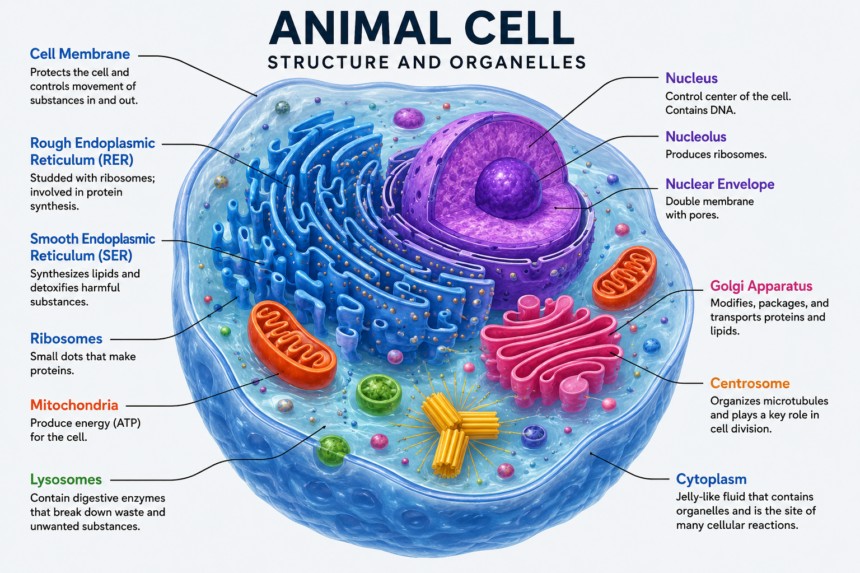
The major parts include the cell membrane, cytoplasm, nucleus, mitochondria, ribosomes, Golgi apparatus, endoplasmic reticulum, lysosomes, and centrosomes.
3. How is an animal cell different from a plant cell?
An Animal cell does not have a cell wall or chloroplasts and usually has small vacuoles. Plant cells have a rigid cell wall, chloroplasts for photosynthesis, and one large central vacuole.
4. Why are mitochondria called the powerhouse of the cell?
Mitochondria produce ATP, the energy molecule that powers almost every activity within an Animal cell, including movement, growth, and protein synthesis.
5. Why is studying animal cells important?
Studying the Animal cell helps scientists understand genetics, disease mechanisms, drug development, biotechnology, tissue engineering, and regenerative medicine, leading to advances in healthcare and scientific research.