Introduction
When people talk about football dynasties, they usually start with quarterbacks, coaches, and highlight-reel moments. Fair enough. That is where the fireworks are. But every now and then, if you look just a little closer, you notice someone working behind the curtain with a calm hand and a long view. That is where this story begins. Clark Hunt is not the loudest figure in the NFL, not by a long shot, yet his influence has shaped one of the league’s most admired organizations in a way that feels both old-school and remarkably modern.
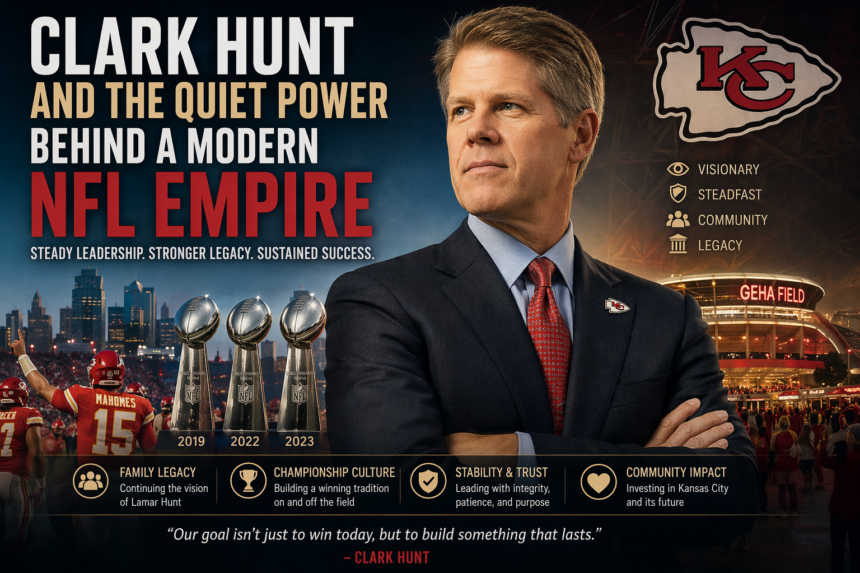
And honestly, that is what makes him interesting. In a sports world addicted to noise, spectacle, and chest-thumping declarations, he comes across as something else entirely: patient, disciplined, and measured. He is the Chairman and CEO of the Kansas City Chiefs, part of the Hunt family that has been tied to the franchise for generations. Since becoming CEO in 2010, the team has piled up division titles, AFC championships, and multiple Super Bowl appearances, turning sustained excellence into something close to routine. The Chiefs are also owned by the families of Lamar Hunt’s four children, including Clark Hunt.
So this article is not just about wins and trophies, though there are plenty of those. It is about leadership that rarely screams for attention. It is about legacy without laziness. It is about what happens when a franchise is guided by someone who seems more interested in building the right culture than chasing the next shiny thing. And, well, in a game where everything can change in a heartbeat, that kind of steadiness matters more than ever.
A Legacy He Did Not Inherit Lightly
Being born into a famous sports family sounds glamorous on paper. In reality, it can be a bit of a tightrope walk. The Hunt name carries real weight in American sports history because Lamar Hunt, Clark’s father, was one of the founding figures behind the American Football League and a major force in the growth of professional football. The Chiefs’ own official materials identify Clark Hunt as the son of founder Lamar Hunt, and the franchise remains tied to that family legacy to this day.
Now, that kind of inheritance can go one of two ways. Some people coast on it. Others spend their whole lives trying to escape it. Clark Hunt, from the look of things, chose a third path: honor it, protect it, and then add to it without turning the whole thing into a personal vanity project.
That is easier said than done. Family legacies can become museum pieces if nobody evolves them. Yet the Chiefs have not felt trapped in nostalgia. Quite the opposite, actually. The organization has managed to preserve its roots while still behaving like a franchise that understands the speed, pressure, and business realities of the modern NFL. That balance does not happen by accident.
What stands out is that Hunt seems to have embraced continuity without becoming stale. He did not arrive waving a banner that said, “Look at me, I’m here to reinvent everything.” Instead, he appears to have approached leadership with a sort of quiet confidence, the kind that says, “Let’s build something durable.” In a culture obsessed with disruption, that can sound boring. But in football? Boring can be brilliant.
Why Clark Hunt’s Leadership Style Feels Different
There is a certain type of sports executive who loves the camera almost as much as the game. They become characters, brands, lightning rods. Clark Hunt does not really fit that mold. His public image is more restrained, almost understated, and that restraint may be one of his biggest strengths.
Leadership, after all, is not always about dominating the room. Sometimes it is about creating a room where smart people can do their jobs well. That sounds simple, but it is not. Too many owners meddle. Too many executives panic. Too many franchises mistake activity for progress. You know the type: constant turnover, splashy statements, and a desperate need to prove they are “doing something.” It can become a circus in no time.
Hunt’s style seems rooted in patience and structure. The Chiefs’ official profile notes that since he became CEO in 2010, the club has earned nine AFC West division championships, including an extended run of consecutive titles, while also winning multiple AFC championships and reaching several Super Bowls after the 2019, 2020, 2022, and 2023 seasons. Those outcomes suggest not chaos, but continuity.
And continuity matters. It gives coaches room to coach. It gives front offices room to plan. It gives players a sense that the organization is not going to lose its mind after one bad week. That sort of environment can be a competitive advantage all by itself.
There is also something deeply human about steady leadership. People tend to do better work when they trust the structure around them. They take smarter risks. They communicate more clearly. They commit more fully. When an owner or CEO projects calm instead of panic, that tone trickles down, whether anyone says it out loud or not.
The Chiefs’ Rise Was Not Magic
Dynasties are often described as if they just materialize. One day a team is struggling, the next day it is holding confetti-soaked trophies. But that is not how it works, not really. Success at that level is usually the result of layered decision-making over time: the right hires, the right patience, the right support systems, the right culture. In other words, no rabbit-out-of-a-hat stuff here.
The Chiefs had a long Super Bowl drought before their modern surge, and under Hunt’s leadership the franchise’s fortunes changed dramatically. The official team biography credits the period after he became CEO with major competitive success, including division dominance and repeated conference titles.
That does not mean one person deserves all the credit. Football is too complex for that. Coaches shape schemes. General managers shape rosters. Players decide games. Still, ownership sets the ceiling. It determines whether excellence is supported or suffocated.
A good owner can do several things that never show up in a box score:
- Hire people with a long-term vision instead of chasing quick fixes
- Resist emotional overreactions after setbacks
- Protect organizational stability during turbulent seasons
- Invest in culture, community, and infrastructure
- Keep the franchise aligned with a clear identity
That last one is huge. Identity is not just a slogan slapped on a wall. It is what people inside the building believe the place stands for. The Chiefs, under Hunt, have increasingly looked like a franchise that expects professionalism, confidence, and sustained contention rather than occasional bursts of relevance.
Clark Hunt and the Art of Staying Measured
One of the trickiest things in sports leadership is staying level when everyone around you is losing their head. Win a championship, and the temptation is to get smug. Lose a big game, and the temptation is to tear the walls down. Both impulses are dangerous.
Measured leaders do something harder: they absorb emotion without being ruled by it.
That is part of what makes Clark Hunt so compelling as a subject. He gives off the impression of someone who understands that success is rented, not owned, and the rent is due every season. There is no finish line in the NFL, only fresh pressure dressed up in new uniforms.
This is where the Hunt family legacy probably matters in a deeper sense. The Chiefs are not just a business asset to be flipped, inflated, or treated like a toy. The organization sits inside a broader family story linked to Lamar Hunt and the wider role the family has played in sports. The Hunt Family Foundation also reflects the family’s ongoing commitment to community philanthropy and service beyond the field.
That broader responsibility may explain the tone of Hunt’s leadership. He does not seem to carry himself like a man borrowing prestige for a season. He acts more like a steward. And stewardship, while not flashy, can be incredibly powerful. It implies care, continuity, and obligation. It means the job is not just to win now, but to leave the organization stronger for whoever comes next.
Frankly, sports could use more of that.
More Than a Trophy Case
Let’s be real for a second: winning changes everything. It shapes reputation, public memory, and even the stories people tell about leadership. A quiet executive on a losing team is called invisible. A quiet executive on a winning team is called composed. Funny how that works, right?
Still, it would be too simplistic to reduce Hunt’s significance to silverware alone. A franchise becomes meaningful not only through championships but through the way it connects with its city, its fans, and its sense of identity. The Chiefs have spent years leaning into that connection, and the organization’s public-facing work includes community initiatives through the Hunt family and team programs.
This matters because sports teams are strange creatures. They are businesses, yes, but they are also emotional landmarks. People attach family memories, hometown pride, and personal rituals to them. Owners and executives who understand that are usually better caretakers of a franchise’s soul.
Hunt seems to understand that football success and civic meaning are intertwined. The team is stronger when the bond with the community is stronger. Fans feel that, even if they cannot always articulate it. They notice when an organization feels rooted instead of transactional.
And maybe that is the trick: modern enough to compete, grounded enough to belong.
What Business Leaders Can Learn From Him
You do not need to care about football to learn something from this kind of leadership story. In fact, some of the best lessons here have nothing to do with helmets or scoreboards.
Here are a few takeaways that apply far beyond sports:
1. Stability is not the enemy of innovation
People often treat stability and ambition like opposites. They are not. Stable organizations can innovate better because they are not constantly putting out internal fires.
2. Patience is a strategy
Not every delay is indecision. Sometimes waiting, observing, and choosing carefully is exactly what strong leadership looks like.
3. Culture beats slogans
A company can print values on a wall all day long. If the daily environment does not match them, nobody buys it.
4. Legacy should be a responsibility, not a shortcut
Inheriting a name, a brand, or a platform means very little unless you do the hard work of extending it with integrity.
5. Quiet confidence travels far
Leaders do not always need to perform their authority. Sometimes the steadiest voice in the room is the one people trust most.
That is the sneaky brilliance here. Clark Hunt’s public persona may seem low-volume, but low-volume leadership can still create high-impact results. Maybe especially then.
The Human Side of Power
Power in sports is often portrayed as swagger. Big speeches. Bold headlines. A little drama for seasoning. But there is another version of power that feels more grounded. Less fireworks, more foundation.
That kind of power is easier to miss because it does not always announce itself. It shows up in consistency. In trust. In the way an organization behaves over time. The Chiefs’ sustained success since Hunt became CEO suggests a franchise shaped by intentional leadership rather than random luck.
And that gets at the human side of all this. Leadership is not just decisions on paper. It is emotional weather. It creates an atmosphere people either flourish in or shrink inside. When a leader stays composed, thinks long-term, and avoids making the whole enterprise about ego, people usually notice. Maybe not in a press conference. But in the work. In the trust. In the results.
By the same token, fans often sense when a franchise is being run with care. They may not know every executive detail, but they can feel whether the place has direction. Whether it feels serious. Whether it behaves like it expects to matter.
That is not a small thing. That is culture made visible.
FAQs About Clark Hunt
Who is Clark Hunt?
Clark Hunt is the Chairman and CEO of the Kansas City Chiefs and a member of the Hunt family, which owns the franchise through the families of Lamar Hunt’s four children.
Is Clark Hunt related to Lamar Hunt?
Yes. Clark Hunt is the son of Lamar Hunt, the founder of the Chiefs and one of the most influential figures in professional football history.
When did he become CEO of the Chiefs?
According to the Chiefs’ official team biography, he became CEO in 2010.
What happened to the Chiefs under his leadership?
Since 2010, the Chiefs have won multiple AFC West titles, several AFC championships, and reached multiple Super Bowls, marking one of the most successful eras in franchise history.
Why do people view his leadership as important?
Because ownership shapes culture, hires, stability, and long-term vision. Hunt is often associated with a steady, disciplined leadership approach that helped support the Chiefs’ sustained success. The factual part of that assessment is reflected in the team’s competitive results under his tenure.
Conclusion
In the end, the most fascinating thing about Clark Hunt may be that he does not fit the usual script. He is not trying to be the star of the story, and maybe that is precisely why his role stands out. He represents a kind of leadership that feels increasingly rare: calm, durable, legacy-aware, and quietly ambitious.
The Kansas City Chiefs’ rise into one of football’s premier organizations did not happen in a vacuum. It happened inside a structure shaped by patience, stability, and a clear sense of purpose. Those are not glamorous words, I know. They do not trend like controversy does. But they build things that last.
And that is the point, really. Some people chase attention. Others build institutions. Hunt, by all appearances, has spent his leadership years doing the latter. No unnecessary noise. No theatrical reinvention. Just a steady hand on the wheel, mile after mile.